|
The Gross National Debt
(Real-Time)
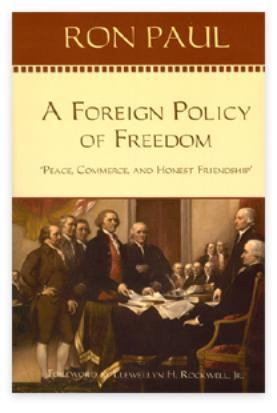
The
Foreign Policy of Ron Paul
by Llewellyn H. Rockwell, Jr.
LewRockwell.com
May 21, 2007
Foreword to Ron Paul’s new book: A Foreign Policy of Freedom: ‘Peace,
Commerce, Honest Friendship’
(Excerpt)
Ron
Paul has always believed that foreign and domestic policy should be conducted
according to the same principles. Government should be restrained
from intervening at home or abroad because its actions fail to achieve
their stated aims, create more harm than good, shrink the liberty of the
people, and violate rights.
Does
that proposition seem radical? Outlandish or far-flung? Once you hear it
stated, it makes perfect sense that there is no sharp
distinction between the principles of domestic and foreign policy. They
are part of the same analytical fabric. What would be inconsistent would
be to favor activist government at home but restraint abroad, or the
reverse: restraint at home and activism abroad. Government unleashed
behaves in its own interests, and will not restrict itself in any area of
life. It must be curbed in all areas of life lest freedom suffer.
If
you recognize the line of thinking in this set of beliefs, it might be
because you have read the Federalist Papers, the writings of
Thomas Jefferson or George Washington or James Madison, or examined the
philosophical origins of the American Revolution. Or you might have
followed the debates that took place in the presidential election of
1800, in which this view emerged triumphant. Or perhaps you read the
writings of the free traders prior to the Civil War, or the opponents of
the War on Spain, or those who warned of entering World War I. Or perhaps
you have read the speeches and books against FDR's New Deal: the same
group warned of the devastating consequences of World War II. Or maybe, in more recent
history, you understood the animating principles behind the Republican
takeover of Congress in 1994: a generation had turned away from all forms
of foreign and domestic "nation building."
(More…)
But
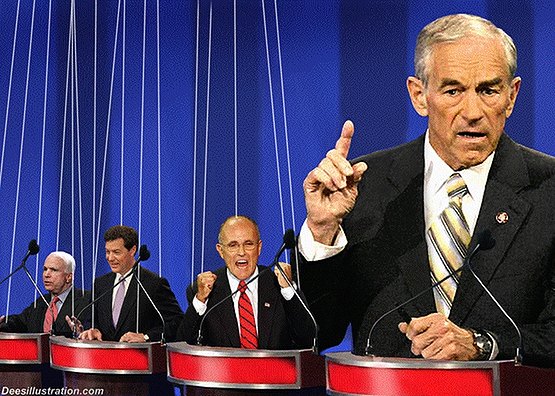
Who Was Right -- Rudy or Ron?
By Patrick Buchanan
May 18, 2007
(Excerpt)
A fair
question and a crucial question.
When Ron
Paul said the 9-11 killers were "over here because we are
over there," he was not excusing the mass murderers of 3,000
Americans. He was explaining the roots of hatred out of which the
suicide-killers came.
Lest we
forget, Osama bin Laden was among the mujahideen whom we, in the Reagan decade,
were aiding when they were fighting to expel the Red Army from
Afghanistan. We sent them Stinger missiles, Spanish mortars, sniper
rifles. And they helped drive the Russians out.
What Ron Paul was
addressing was the question of what turned the allies we aided into
haters of the United States. Was it the fact that they discovered we
have freedom of speech or separation of church and state? Do they hate us
because of who we are? Or do they hate us because of what we do?
Osama bin Laden in his
declaration of war in the 1990s said it was U.S. troops on the sacred
soil of Saudi Arabia, U.S. bombing and sanctions of a crushed Iraqi
people, and U.S. support of Israel's persecution of the Palestinians that were the reasons he
and his mujahideen were declaring war on us.
Elsewhere,
he has mentioned Sykes-Picot, the secret British-French deal that double-crossed
the Arabs who had fought for their freedom alongside Lawrence of Arabia
and were rewarded with a quarter century of British-French imperial
domination and humiliation. Almost all agree that, horrible as 9-11 was,
it was not anarchic terror. It was political terror, done with a
political motive and a political objective.
What does
Rudy Giuliani think the political motive was for 9-11?
Was it
because we are good and they are evil? Is it because they hate our
freedom? Is it that simple?
Ron Paul
says Osama bin Laden is delighted we invaded Iraq.
Does the
man not have a point? The United States is now tied down in a bloody
guerrilla war in the Middle East and increasingly hated in Arab and
Islamic countries where we were once hugely admired as the first and
greatest of the anti-colonial nations. Does anyone think that Osama is
unhappy with what is happening to us in Iraq?
Of the 10 candidates on stage
in South Carolina, Dr. Paul alone opposed the war. He alone voted against
the war. Have not the last five years vindicated him, when two-thirds of
the nation now agrees with him that the war was a mistake, and
journalists and politicians left and right are babbling in confession,
"If I had only known then what I know now ..."
Rudy
implied that Ron Paul was unpatriotic to suggest the violence against us
out of the Middle East may be in reaction to U.S. policy in the Middle
East. Was President Hoover unpatriotic when, the day after Pearl Harbor,
he wrote to friends, "You and I know that this continuous putting
pins in rattlesnakes finally got this country bitten."
Pearl
Harbor came out of the blue, but it also came out of the troubled history
of U.S.-Japanese relations going back 40 years. Hitler's attack on Poland
was naked aggression. But to understand it, we must understand what was
done at Versailles — after the
Germans laid down their arms based on Wilson's 14 Points. We do not
excuse — but we must understand.
Ron Paul is
no TV debater. But up on that stage in Columbia, he was speaking
intolerable truths. Understandably, Republicans do not want him
back, telling the country how the party blundered into this misbegotten
war.
By all means, throw out
of the debate the only man who was right from the beginning on Iraq.
(More…)
Giuliani
a Fake
By Charley Reese
LewRockwell.com
May 21, 2007
(Excerpt)
Rep.
Ron Paul of Texas, the only intellectually honest candidate in the bunch,
correctly pointed out that it was our policy of inter-ventionism that
caused the attack on 9/11.
Former New York Mayor Rudy Giuliani, intensely
uncomfortable at having been forced to talk about his liberal positions
on abortion, gun control and gay rights, leaped at the opportunity to
reprimand Paul for suggesting that we had invited the attack. "I've
never heard that," Giuliani snapped, showing that he is ignorant
even on matters of security, and demanded that Paul retract it. He
didn't, of course. But Giuliani got a big round of applause, as if he had
come to the defense of America rather than just cleverly change the
subject.
Osama bin Laden, the author of those attacks, has said quite
plainly, publicly and explicitly that the attack was prompted by our
intervention in the Muslim world. It is outrageous that Giuliani
claims not to know that, given that his whole campaign is based on his
claim of being the best-qualified leader in matters of security and the
so-called war on terror.
Actually, Giuliani isn't an expert on security.
He's a lawyer and a political hack. The
attack on 9/11 was a political gift of the gods to him. He walked up and
down the street in front of the television cameras, gave speeches and
went to funerals, and for that he received the accolades of the press.
Giuliani is not a leader. He is a cynical exploiter. He exploited the
attack the day it happened, and he's exploited it since to make a fortune
posing as an expert security consultant. Now he hopes to exploit the
tragedy, which, like the president, he had done nothing to prevent, to
get the Republican nomination for the presidency.
By demonstrating his ignorance of the cause of the
attack, he has disqualified himself from consideration.
(More…)
Despite
Unprecedented Media Manipulation And Disinformation Americans Are
Beginning To Understand That Washington’s Disastrous ‘Foreign Policy’ Has
Brought Terror And Disgrace To Our Homeland
CNN Poll
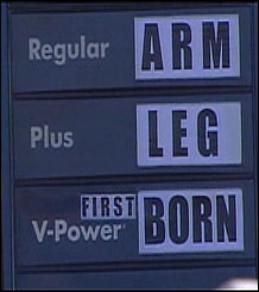
Gasoline hits record high
for 2nd week
Energy Information Administration says average
price jumped 11.5 cents to $3.22 a gallon.
CNNMoney.com
May
21, 2007
Oil prices surge on Nigeria
unrest, US refinery woes
Forbes, NY
May 21, 2007
(Excerpt)
NEW
YORK (XFN-ASIA) - World oil prices rose on Monday as the market saw no
end to concerns over tight supplies caused by unrest in key crude
producer ... in key crude producer Nigeria and output disruptions at US
refineries, traders said.
New York's main oil futures contract, light sweet
crude for delivery in June, gained 1.33 usd to close at 66.27 usd a
barrel.
(More…)
China begins to shift massive foreign reserves (U.S.
Dollars) into private investments...
Kuwait
abandons currency peg to dollar, neighbouring Gulf states may follow
Forbes
May 21, 2007
(Excerpt)
The
Kuwaiti central bank said it was worried
about the decline of the US dollar, which by dragging the
dinar lower had contributed to higher inflation in Kuwait, and that the
move was intended to stave off inflation.
(More…)
Why
The U.S. Government Is Now Hated All Over The World
“Americans
really are good folk. The government isn’t. It’s the gravest problem we
face, both internationally and domestically.”
By Fred Reed
LewRockwell.com
May 21, 2007
(More…)
America: A Lost
Mythic Authority
No one is paying much
attention to it, but the United States remains the World’s top merchant
of militariasm and death.
By Frida Berrigan
Los Angeles Times
May 21, 2007
(Excerpt)
THEY DON'T
CALL US the sole superpower for nothing. Paul Wolfowitz might be looking
for a new job right now, but the term he used to describe the
pervasiveness of U.S. power back when he was a mere deputy secretary of
Defense — hyperpower — still fits the bill. Consider some of the areas in
which the United States is still No. 1:
• First in weapons sales: Since 2001,
U.S. global military sales have totaled $10 billion to $13 billion.
That's a lot of weapons, but in fiscal 2006, the Pentagon broke its own
recent record, inking arms sales agreements worth $21 billion.
• First in sales of surface-to-air missiles:
From 2001 to 2005, the U.S. delivered 2,099 surface-to-air missiles like
the Sparrow and AMRAAM to nations in the developing world, 20% more than
Russia, the next largest supplier.
• First in sales of military ships: During that
same period, the U.S. sent 10 "major surface combatants," such
as aircraft carriers and destroyers, to developing nations. Collectively,
the four major European weapons producers shipped 13.
• First in military training: A thoughtful
empire knows that it's not enough to send weapons; you have to teach
people how to use them. The Pentagon plans on training the militaries of
138 nations in 2008 at a cost of nearly $90 million. No other nation
comes close.
Rest assured, governments around the
world, often at each others' throats, will want U.S. weapons long after
their people have turned up their noses at a range of once dominant
American consumer goods. The "trade"
publication Defense News, for instance, recently reported that Turkey and
the U.S. signed a $1.78-billion deal for Lockheed Martin F-16 fighter
planes. As it happens, these planes are already ubiquitous — Israel flies
them; so does the United Arab Emirates, Poland, South Korea, Venezuela,
Oman and Portugal, among others. Buying our weaponry is one of the
few ways you can actually join the American imperial project!
In order to remain on top in the competitive jet field, Lockheed Martin,
for example, does far more than just sell airplanes. TAI — Turkey's
aerospace corporation — will receive a boost with this sale because
Lockheed Martin is handing over responsibility for portions of
production, assembly and testing to Turkish workers.
The Turkish air force already has 215 F-16 fighter planes and plans
to buy 100 of Lockheed Martin's new F-35 Joint Strike Fighter as well, in
a deal estimated at $10.7 billion over the next 15 years. That's
$10.7 billion on fighter planes for a country that ranks 94th on the United
Nations' human development index, below Lebanon, Colombia and Grenada and
far below all the European nations that Ankara is courting as it seeks to
join the European Union. Now that's a real American sales job for you!
HERE'S THE strange thing, though: This genuine, gold-medal
manufacturing-and-sales job on weapons simply never gets the attention it
deserves. As a result, most Americans have no idea how proud they should
be of our weapons manufacturers and the Pentagon — essentially our global
sales force. They make sure our weapons travel the planet and regularly
demonstrate their value in small wars from Latin America to Central Asia.
(More…)
US 'Tried to Get Sadr to Talks to Kill
Him'
Exclusive: Secret US plot to kill
Al-Sadr
By
Patrick Cockburn In Baghdad
The Independent – London (UK)
May
21, 2007
(Excerpt)
The US Army tried to kill or capture Muqtada al-Sadr, the widely revered Shia cleric, after luring him to peace negotiations at a house in
the holy city of Najaf, which it then attacked, according to a senior
Iraqi government official.
The revelation of this extraordinary plot, which
would probably have provoked an uprising by outraged Shia if it had
succeeded, has left a legacy of bitter distrust in the mind of Mr
Sadr for which the US and its allies in Iraq may still be paying. "I believe that particular
incident made Muqtada lose any confidence or trust in the [US-led]
coalition and made him really wild," the Iraqi National Security Adviser
Dr Mowaffaq Rubai'e told The Independent in an interview. It is not
known who gave the orders for the attempt on Mr Sadr but it is one of
a series of ill-considered and politically explosive US actions in Iraq
since the invasion. In January this year a US helicopter assault team
tried to kidnap two senior Iranian security officials on an official
visit to the Iraqi President. Earlier
examples of highly provocative actions carried out by the US with little
thought for the consequences include the dissolution of the Iraqi army
and the Baath party.
More…
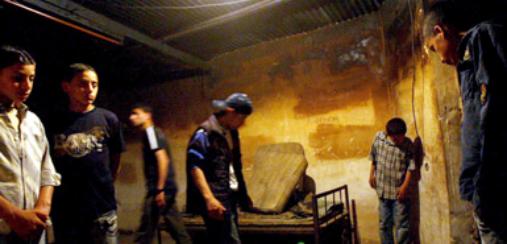
(Mohammed Saber/EPA) Eight people
were killed in the attack which left bloodstains on the
walls and floor of the house
Israeli IDF
Launches Yet Another ‘U.S. Encouraged’ Terror Raid Against Gaza
Palestinians – Threatens To Assassinate Hamas Political Leaders
Hamas vows revenge as Israel targets leadership
Times Online (London, UK)
5.21.07
(Excerpt)
An
Israeli Cabinet minister called today for the assassination of the exiled
Hamas leader Khaled Mashaal as Israel stepped up its air campaign in the
Gaza Strip.
Thousands
of Hamas supporters took to the streets of Gaza City, gunmen firing into
the air, vowing to avenge an air strike on the house of a Hamas
politician in which eight people were killed last night.
The MP,
Khalil al-Haya, was not wounded in last night's attack although he
said that he had lost seven family members in the attack. Hamas said that only two of those killed were
militants, while Israel insisted that the attack had targeted a group of
five armed men.
(More…)
Why
Did They Torture Jose Padilla?
by John
Grant
Future of
Freedom Foundation (FFF.org)
May 21,
2007
(Excerpt)
There’s
a rancid odor escaping from the cracks in the Jose Padilla case. Padilla
is the American citizen arrested in Chicago and declared by President
Bush to be an “enemy combatant.” He was then kept for nearly two
years in a South Carolina brig without access to a lawyer,
family, or friends.
The
courts finally forced the Bush administration to release Padilla into the
justice system, and he is now imprisoned in Miami awaiting trial on
charges that have nothing to do with what he was arrested for — an
alleged plot to use a dirty bomb in the United States. It is claimed he
had al-Qaeda connections.
What
makes this case so insidious is that, according to a psychiatrist who
examined him over a 22-hour period, the treatment Padilla received in the
South Carolina brig was such that he now “lacks the capacity to assist in
his own defense.” In other words, a U.S. citizen was secretly worked over
for 21 months to the point he is unable to think well enough to engage
with his lawyer.
What
needs to be pointed out is that the procedures that broke down
Padilla’s mental equilibrium weren’t dreamed up by his jailers in South
Carolina. According to Alfred McCoy in a new book called A
Question of Torture,
they are the result of decades and billions of dollars of
taxpayer-funded research.
“From
1950 to 1962,” McCoy writes,
the
CIA became involved in torture through a massive mind-control effort,
with psychological warfare and secret research into human consciousness
that reached a cost of a billion dollars annually — a veritable Manhattan
Project of the mind.
This
research amounted to “the first real revolution in the cruel science of
pain in more than three centuries.” This “black budget” research has
never stopped and elements of it were rushed into practice after 9/11.
(More…)
Padilla Gets Day in Court, But Verdict on Bush Is In: by Robyn Blumner St.
Petersburg Times
AFGHANISTAN:
As US, NATO Turn to Airpower, Civilian
Casualties Mount
AFP
May 21, 2007-05-21
Some analysts say too few troops on the ground,
coupled with allied sensitivities about using ground forces and taking casualties,
have made air power an irresistible option.
(Excerpt)
Over the
past month, Afghan officials reported 50 civilians killed in US air
strikes in fighting in the western province in Herat, and another 21 in
south central Helmand province.
They followed
a string of similar incidents last year as fighting intensified between
NATO and Taliban forces, many of them involving air strikes called in by
troops in the heat of battle.
"Every time that
happens someone walks away .. with a bad feeling either to NATO or the
United States or its coalition members. That's what we don't want to
happen," General
Bantz Craddock, NATO's supreme allied commander, told reporters Friday.
The deaths
have sparked public outrage at a time when NATO is facing a major
challenge from the Taliban, creating a dilemma for commanders over
whether the gains offered by air strikes are worth the loss in public
support.
(More…)
Armenia, an ally of both
countries [U.S. & Iran], shows how tensions between the two could
upset the region's diplomatic balancing act.
By
Nicole Itano
The
Christian Science Monitor
5.21.07
(Excerpt)
YEREVAN,
ARMENIA: In late March, as the United Nations Security Council debated
whether to increase sanctions against Iran over that country's refusal to
halt its nuclear program, Iranian President Mahmoud Ahmadinejad and his
Armenian counterpart met near the border of the two countries to
inaugurate a new pipeline bringing Iranian natural gas to fuel Armenian cities.
Lighting
a symbolic flame, Armenian President Robert Kocharian called the ceremony
"evidence of our friendship." But it's a relationship some of
Armenia's other friends –
particularly
the US –
wish weren't quite so cozy.
As
tensions between Iran and the West approach a boiling point, Armenia is
finding it increasingly difficult to negotiate the often conflicting
alliances in its complicated neighborhood. Its precarious position
illustrates the potentially destabilizing consequences of a Western standoff
with Iran on not only the Middle East, but the South Caucasus as well.
(More…)
“MAD DOG” BOLTON: Threatens Traditional Peace-Negotiating Swiss
Over Iran Nuclear Negotiations
Swiss
told to stay out of Iran nuclear crisis
NZZ Online – Switzerland
May 21, 2007
(Excerpt)
The former American ambassador to the United Nations, John
Bolton, has called the so-called "Swiss plan" to end the
Iranian nuclear standoff "farcical".
Bolton warned that Switzerland
would be better off keeping its nose out of the current crisis between
Tehran and the West over Iran's enrichment of uranium.
In an interview with the "Sonntagszeitung"
newspaper, he said the Swiss proposal ? which has never been confirmed by
the foreign ministry ? was nothing more than an illusion.
(More…)
By Andrew England
The Financial Times (FT.com)
May 21 2007
(Excerpt)
The Lebanese army pounded a Palestinian refugee camp with tank and artillery
fire on Monday as it sought to target Islamist militants who had killed
27 soldiers a day earlier during the worst fighting in northern
Lebanon since the end of the country’s
civil war.
(More…)
55 Dead as
Lebanon Army Fights Militants, Blast Hits Beirut
AFP
May
21, 2007
By Ferry Biedermann
The Financial Times (FT.com)
May 17 2007
(Excerpt)
Bombs have rained down on Lebanon in the past year and the winds of
sectarian strife are still buffeting the country, but this is exactly the
kind of political weather that suits hashish farmers in the fertile
eastern Bekaa -valley.
“I'm going for broke and I hope that the
country falls apart,” is how
one small farmer near the hamlet of Alaaq recently put it.
(More…)
AFRICA'S IN PLAY!
China and USA in New Cold War over Africa’s Oil Riches
by F.
William Engdahl
GlobalResearch.ca
May
20, 2007
(Excerpt)
To paraphrase the famous
quip during the 1992 US Presidential debates, when an unknown William Jefferson
Clinton told then-President George Herbert Walker Bush, “It’s the
economy, stupid,” the
present concern of the current Washington Administration over Darfur in
southern Sudan is not, if we were to look closely, genuine concern over
genocide against the peoples in that poorest of poor part of a forsaken
section of Africa.
No. “It’s the
oil, stupid.”
Hereby hangs a tale of
cynical dimension appropriate to a Washington Administration that has shown
no regard for its own genocide in Iraq, when its control over major oil
reserves is involved. What’s at
stake in the battle for Darfur? Control over oil, lots and lots of oil.
(More…)
Vatican-sized
bomb-proof structure to cost £300m
Builders in Green Zone already insurgent targets
The Guardian
– London
5.21.02
(Excerpt)
Rising from
the dust of the city's Green Zone it is destined, at $592m (£300m), to
become the biggest and most expensive US embassy on earth when
it opens in September.
It will cover 104
acres (42 hectares) of land, about the size of the Vatican. It will
include 27 separate buildings and house about 615 people behind
bomb-proof walls. Most of the embassy staff will live in simple, if not quite
monastic, accommodation in one-bedroom apartments.
The US ambassador,
however, will enjoy a little more elbow room in a
high-security home on the compound reported to fill 16,000 square feet
(1,500 sq metres). His deputy will have to make do with a more modest
9,500 sq ft.
They will have a
pool, gym and communal living areas, and the embassy will have its own
power and water supplies.
But commentators
and Iraq experts believe the project was flawed from its inception, and
have raised concerns it will become an enormous, heavily targeted white
elephant that will be an even greater liability if and when the Americans
scale back their presence in Iraq [Perspective].
(More…)
Current News & Views
·
US death toll rising in
Baghdad
·
US Intel
Assessments Made in 2003 Foretold Situation in Iraq
·
U.S.
Raids Don't Find 3 Missing Soldiers
·
Iraq Makes Plans for
Quick U.S. Pullout
·
Afghanistan's
Civilian Victims: by Joanne Mariner Findlaw.com
·
Four injured in Beirut blast
·
World
Bank Says Wolfowitz Will Resign: World Bank's board announces that Washington’s controversial
and much-despised president has resigned and will step down at the
end of June.
·
Bush wants an American as
new World Bank Chief
·
"Bribes" in Congress? Hardly Surprising in World of
Politics: by Donald J. Boudreaux USA Today
·
EXCITEABLE
BOYS (AND GIRLS?) Study Links Imprisoned Veterans With Sex Crimes: Military personnel in
prison are more than twice as likely to have been convicted for sex
offenses than non-veteran inmates, the government reports.
|
An extraordinarily prescient TV
interview with General Norman Schwarzkopf and Robert Gates - Deputy
National Security Advisor to Former President George Bush Sr.
Why
Invading Iraq Was A Very Stupid Idea…

(Click on blinking
dot above for video)
|
|